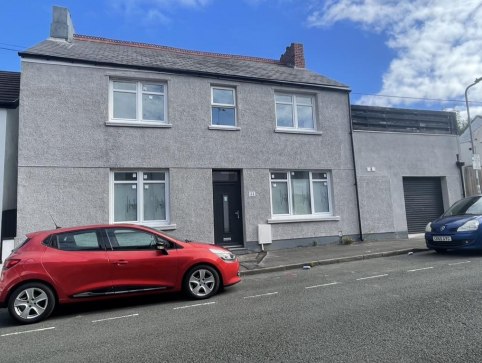
Newport, South Wales — security property
£128,250 Bridging Loan. Enquiry to Completion in 17 Days, One Day Before the Deadline.
A borrower in Newport, South Wales needed to refinance an existing bridging facility against a hard redemption deadline. A previous lender had held the case for a month, reached legals, then withdrawn over the property's planning history. A valuation report already existed, but it had been prepared on the wrong instructions. AF Credit instructed no valuation at all, inspected the property internally, ran its own residual calculation, and completed with a day to spare.
Newport, South Wales — security property
| Item | Detail |
|---|---|
| Transaction Type | Rebridge — refinance of an existing bridging facility |
| Location | Newport, South Wales |
| Property Type | Mid-terrace house, reverting to a five-bedroom C3 dwelling |
| Gross Facility | £128,250 |
| LTV | 75% |
| Monthly Rate | 0.99% per month, fixed |
| Term | 9 months |
| Valuation Method | No valuation — internal inspection and residual appraisal by AF Credit |
| Valuation Fee | £0 |
| Principal Obstacle | Unresolved planning history; prior lender withdrew |
| Remedial Works | ~£9,000, deducted from the view of value |
| Completion Time | 17 days from initial enquiry |
| Exit Strategy | Refinance onto a term facility once planning is regularised |
A rebridge is a bridging loan used to refinance an existing bridging loan. Borrowers need one when the original facility reaches the end of its term before the planned exit has happened — a sale that has not completed, a refinance that has slipped, or, as here, a lender who agreed to refinance and then withdrew. It is not a sign the deal has failed. It buys the time to finish the exit properly instead of defaulting on a loan secured against the property. Our guide to refinancing a bridging loan covers how they are structured and what lenders look for.
Underwritten and funded by AF Credit as principal. This case study concerns a £128,250 unregulated bridging facility completed on 15 October 2026, following an internal property inspection and an in-house security assessment. Borrower details have been anonymised.
The borrower held a property in Newport with an existing bridging facility approaching its redemption date. The deadline was fixed and close. Miss it and the borrower would be in default on a loan secured against the property.
A refinance had already been arranged — or so it appeared. Another lender had taken the case on, progressed it as far as legals, and then withdrawn. The stated reason was the property's planning history. That history had not changed at any point during the month the case sat with them; it was visible from the first day. The borrower lost four weeks and arrived at AF Credit with the deadline far closer than when they started.
There was a further complication. A valuation report on the property already existed, but it had been prepared on the wrong instructions — commissioned for a different basis than the transaction actually required. It could not simply be relied upon, and re-instructing a fresh valuation would have consumed days the borrower did not have, and money they had already spent once.
The planning history was genuinely messy, which is precisely why it had frightened off a lender working to a checklist.
In short: the property's lawful planning status was a grey area, and nobody could produce a document that made it black and white inside the deadline.
We did not need the planning position resolved. We needed to be confident the loan was safe if it never was.
We instructed no valuation. Instead of commissioning a third report, we inspected the property internally ourselves. That told us what a desktop exercise could not: the actual condition, the standard of the works already done, and what remained to turn it back into a conventional five-bedroom house.
We ran our own numbers. Alongside the inspection we completed a residual calculation in-house: the end value of the property as a finished five-bedroom dwelling, less the outstanding works of roughly £9,000, less an allowance for the time and risk of getting there. That produced the value we were prepared to lend against on the day, rather than a figure that assumed the works were already done. It landed close to what the borrower needed, so the deal stood up without stretching the LTV to make it fit.
We lent against the building, not a planning outcome. The planning position was unresolved and we did not treat it as settled. We assessed the security as a conventional five-bedroom house — the use the borrower was reverting to, and the use the building is physically suited to — and asked whether the loan was safe on that basis alone. No part of the decision depended on an HMO consent being granted, or on the 2007 permission proving to be live. Had the planning never progressed, the security still supported the facility.
We dealt with the search risk rather than waiting on it. Local authority search timescales would have run past the deadline on their own. A personal local search was commissioned instead, backed by a search indemnity policy. To be precise about what that policy did: it covered the risk of something adverse being revealed by a search that had not been returned in full — it did not cure, regularise or insure the planning position itself, and it was never intended to. The planning remained the borrower's to resolve; the indemnity simply stopped an unpredictable council backlog dictating whether the deadline was met.
Yes. Refinancing one bridging loan with another is commonly called a rebridge. It is used when an existing facility is reaching the end of its term before the original exit has completed, or when a lender has failed to perform. AF Credit treats a rebridge like any other case: the question is whether the security supports the loan and whether the new exit is credible and deliverable within the term.
Often yes. Unresolved or lapsed planning permission is a common reason mainstream lenders decline. AF Credit lends against the property in its current, lawful condition rather than against a planning outcome that has not yet been granted. Where planning history is unclear, the risk can usually be managed through a conservative view of value, a deduction for any works required, and an appropriate indemnity policy.
Yes. AF Credit offers no valuation bridging loans using an AVM on qualifying residential property, or a desktop valuation up to 75% LTV. Where a case warrants it we will inspect a property internally ourselves and run our own residual calculation rather than instructing a surveyor, which removes both the valuation fee and the delay of booking an inspection.
AF Credit aims to issue indicative terms the same day, and in suitable cases can complete in days rather than weeks where the file is clean and the borrower is responsive. Timescales depend on the individual case. In this Newport case, terms were issued on the afternoon of the first enquiry and the facility completed 17 days later, one day before the borrower's redemption deadline.
It happens more often than borrowers expect, usually late and usually over an issue that was visible at the outset. The priority is a lender who will give a straight answer quickly. AF Credit provides an instant online quote and same-day indicative terms, so a borrower knows within hours whether a deal is supportable rather than losing weeks to a lender that was never going to complete.
The planning history was not a detail anyone discovered late. It was there from the start, and it was the whole reason the case needed a lender who could think about it rather than score it. Pricing the risk and lending conservatively took hours. Waiting for certainty that was never going to arrive in time would have cost the borrower the property. We lend on the same basis across our bridging loan products, and more completed transactions are set out in our bridging loan case studies.
RelatedWhether your current facility is approaching maturity, your exit has slipped, or another lender has withdrawn, we will assess the security and give you an answer. No valuation options may be available on suitable property, subject to underwriting.
Get a rebridging quoteDisclaimer: This case study reflects a real completed transaction. Client details have been anonymised to protect confidentiality. All lending is subject to underwriting and credit approval is not guaranteed. Any property used as security may be repossessed if you do not repay your loan within the agreed term. AF Credit provides unregulated bridging finance only — loans secured on your main residence are not available. AF Credit is a trading style of Avalon Financial Limited, Company No. 16865484.